
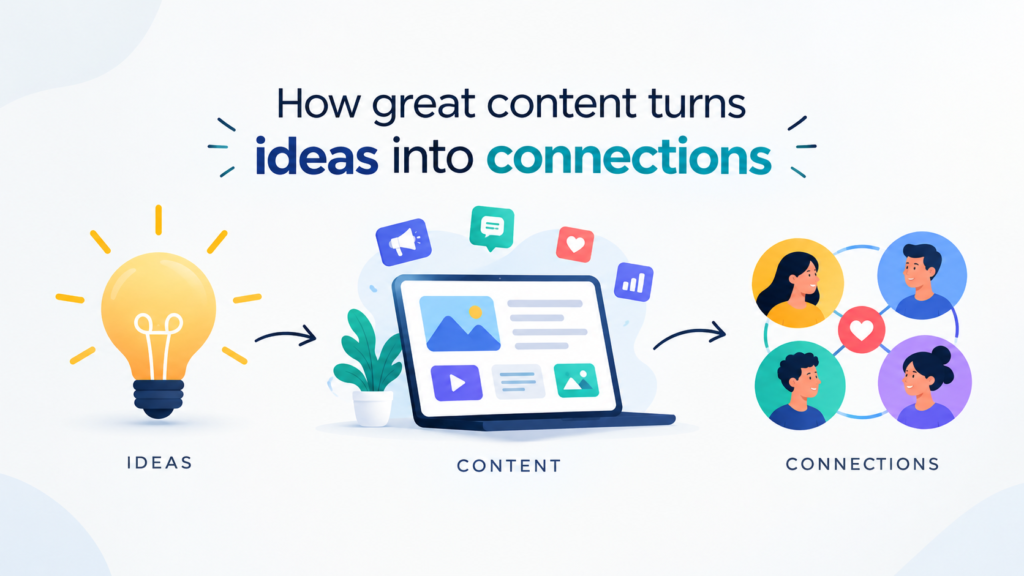
HOW GREAT CONTENT TURNS IDEAS INTO CONNECTIONS
Introduction
In today’s competitive digital world, content plays an important role in how businesses communicate with their audiences. People search online for information, solutions, recommendations, and inspiration before making decisions. Businesses that provide useful and engaging content can build stronger relationships with their audiences and create a recognizable online presence.
Content marketing is a digital marketing strategy that focuses on creating and sharing valuable, relevant, and consistent content to attract and engage a clearly defined audience. Instead of concentrating only on selling products or services, it aims to educate, inform, entertain, and help people.
Content can take many forms, including blog articles, social media posts, videos, infographics, email newsletters, and podcasts. When content is created with a clear purpose, it can help businesses communicate their message, demonstrate their expertise, and support long-term growth.
What Is Content Marketing?
Content marketing is the process of planning, creating, publishing, and distributing content that meets the needs and interests of a target audience.
For example, a digital marketing agency might publish blog articles about SEO, create Instagram reels with marketing tips, and share guides about building a professional website. These resources help people learn while introducing them to the agency’s knowledge and services.
Unlike traditional advertising, which often focuses directly on promoting a product, content marketing emphasizes providing value. The goal is to build awareness and trust so that people can make informed decisions when they need a particular product or service.
Effective content marketing requires more than posting regularly. It involves understanding the audience, choosing relevant topics, maintaining quality, and measuring whether the content achieves its intended purpose.
Why Is Content Marketing Important?
Content marketing helps businesses communicate with customers in ways that are useful and meaningful.
When a business consistently shares helpful information, it gives its audience a reason to pay attention and return for more. Over time, valuable content can help establish the business as a reliable source of information in its field.
Content marketing also supports other digital marketing activities. Blog articles can improve opportunities for organic search visibility, social media posts can introduce content to new audiences, and email newsletters can help maintain communication with interested subscribers.
Another important benefit is that content can answer questions before a customer contacts a business. A detailed service guide, for example, may explain what a service includes, who it is suitable for, and how the process works.
This helps potential customers understand the business and decide whether its offerings match their needs.
Different Types of Content Marketing
1. Blog Articles
Blog articles allow businesses to share detailed information, explain concepts, answer common questions, and demonstrate expertise.
A digital marketing blog might cover topics such as SEO basics, social media strategies, website design, or content creation tips.
Well-written articles can provide lasting value when they are accurate, relevant, and regularly updated. They may also attract visitors through search engines when they match users’ search needs.
2. Social Media Content
Social media content helps businesses communicate with audiences through platforms such as Instagram, Facebook, LinkedIn, and other relevant channels.
Common formats include image posts, carousel posts, stories, short videos, polls, and educational graphics.
For example, a digital marketer could create a carousel explaining five SEO tips or publish a reel demonstrating a website design process.
The content should suit the platform and offer a clear reason for people to engage with it.
3. Video Content
Video content is a useful way to explain ideas, demonstrate products, share stories, and communicate information visually.
Businesses can create tutorials, product demonstrations, interviews, behind-the-scenes videos, and promotional content.
Videos can make certain topics easier to understand and give brands another way to express their personality. Captions, clear audio, and thoughtful editing can improve the viewing experience.
4. Infographics
Infographics present information through a combination of visuals, short text, numbers, and illustrations.
They can be useful for explaining processes, summarizing research, comparing concepts, or presenting statistics.
A clear infographic helps readers understand information quickly without needing to read a long article.
5. Email Newsletters
Email newsletters allow businesses to share updates, useful resources, educational information, and relevant offers with subscribers.
They can help maintain relationships with people who have chosen to receive communications from a business.
Successful email content should be relevant, easy to read, and respectful of subscribers’ preferences.
6. E-books and Guides
Long-form resources such as e-books, checklists, and downloadable guides allow businesses to explain subjects in greater detail.
For example, a marketing professional might create a beginner’s guide to social media marketing or a checklist for launching a business website.
These resources can demonstrate expertise and help readers solve specific problems.
Benefits of Content Marketing
Builds Brand Awareness
Publishing relevant content gives people more opportunities to discover and recognize a business. Consistent messaging and a clear visual identity can help the brand become more memorable.
Builds Trust and Credibility
Accurate, helpful information demonstrates that a business understands its subject and cares about its audience’s needs.
Trust develops over time through consistency, transparency, and content that delivers on its promises.
Supports SEO
Useful articles, well-structured pages, and relevant information can help search engines understand a website’s purpose. Content should be created primarily for people rather than written solely to include keywords.
Encourages Audience Engagement
Interesting and relevant content can encourage people to comment, share, ask questions, and explore additional resources.
Engagement provides opportunities for businesses to understand their audience better.
Supports Lead Generation
Content can introduce potential customers to a business and guide them toward useful next steps, such as subscribing to a newsletter, requesting information, or exploring a service.
A clear call to action can help readers understand how to continue.
Provides Long-Term Value
Some content, particularly helpful blog articles and educational guides, can remain useful for months or years. Updating it when information changes can help maintain its relevance.
How to Create an Effective Content Marketing Strategy
Step 1: Define Your Goals
Decide what you want your content to achieve. Goals might include increasing brand awareness, attracting website visitors, generating enquiries, or educating customers.
Step 2: Understand Your Audience
Research the questions, interests, challenges, and needs of your target audience. Content becomes more useful when it addresses real concerns.
Step 3: Choose the Right Content Formats
Select formats that suit your audience, resources, and goals. For example, tutorials may work well as videos, while detailed explanations may be more suitable for blog articles.
Step 4: Create a Content Calendar
Plan topics, formats, publishing dates, and distribution channels. A content calendar helps maintain consistency and reduces last-minute planning.
Step 5: Focus on Quality
Use clear language, accurate information, original ideas, and attractive presentation. Every piece of content should offer a meaningful benefit to its intended audience.
Step 6: Distribute Your Content
Publish content on relevant platforms and adapt it to each channel. A blog article might become a short video, a carousel post, or a newsletter summary.
Step 7: Measure Performance
Track suitable metrics, such as website visits, time spent on pages, social engagement, newsletter clicks, or qualified enquiries.
Use these insights to identify successful topics and improve future content.
Common Content Marketing Mistakes to Avoid
One common mistake is creating content without understanding the audience. Another is focusing entirely on sales messages instead of providing useful information.
Businesses may also publish inconsistently, copy competitors, overlook accuracy, or ignore performance data.
To avoid these problems, develop a clear strategy, maintain an original voice, verify important information, and review your content regularly. Quality and relevance are more valuable than publishing large amounts of content without a clear purpose.
The Future of Content Marketing
Content marketing continues to evolve as audiences discover information through search engines, social media, video platforms, and AI-powered tools.
Short-form videos, interactive resources, personalized communication, and educational content are creating new opportunities for businesses to connect with people.
AI tools can assist with brainstorming, outlining, and editing, but human review is essential to ensure originality, accuracy, relevance, and a natural brand voice.
Businesses that combine technology with creativity and a genuine understanding of their audience can develop more meaningful content experiences.
Conclusion
Content marketing is more than writing blog posts or publishing social media updates. It is about understanding people, answering their questions, sharing useful knowledge, and building relationships through valuable communication.
By choosing relevant topics, using suitable formats, maintaining consistency, and measuring results, businesses can create content that supports brand awareness, audience engagement, SEO, and lead generation.
The strongest content strategies focus on helping people rather than simply attracting attention. When content provides genuine value, it can become an important part of a business’s long-term digital marketing success.
Create with purpose. Share valuable ideas. Build connections through content.